Data Structures Practical 17
Question 1
Write a C program to perform following operations on Stack as Linked List. PUSH (10), PUSH (20), POP, PUSH (10), PUSH (20), POP, PUSH (20), POP.
stack.c
C
				#include <stdio.h>
#include <conio.h>
#include <stdlib.h>

struct stack
{
    int element;
    struct stack *next;
};

struct stack *top = NULL;

void push(int);
int pop();
void display();

void main()
{
    int poppedVal;
    clrscr();

    printf("--- Executing Sequential Linked Stack Operations ---\n\n");

    printf("Operation: PUSH(10)\n");
    push(10);
    display();

    printf("Operation: PUSH(20)\n");
    push(20);
    display();

    printf("Operation: POP\n");
    poppedVal = pop();
    if (poppedVal != -1) printf("Popped: %d\n", poppedVal);
    display();

    printf("Operation: PUSH(10)\n");
    push(10);
    display();

    printf("Operation: PUSH(20)\n");
    push(20);
    display();

    printf("Operation: POP\n");
    poppedVal = pop();
    if (poppedVal != -1) printf("Popped: %d\n", poppedVal);
    display();

    printf("Operation: PUSH(20)\n");
    push(20);
    display();

    printf("Operation: POP\n");
    poppedVal = pop();
    if (poppedVal != -1) printf("Popped: %d\n", poppedVal);
    display();

    printf("\nExecution completed. Press any key to exit...");
    getch();
}

void push(int value)
{
    struct stack *ptr;
    ptr = (struct stack *)malloc(sizeof(struct stack));
    ptr->element = value;
    ptr->next = top;
    top = ptr;
    return;
}

int pop()
{
    int num;
    struct stack *temp;
    if (top == NULL)
    {
        printf("\nSTACK is Empty.");
        return -1;
    }
    else
    {
        num = top->element;
        temp = top;
        top = top->next;
        free(temp);
        return (num);
    }
}


void display()
{
    if (top == NULL)
    {
        printf("Stack is empty\n");
        return;
    }
    struct stack *ptr1 = NULL;
    ptr1 = top;
    printf("Current Stack Status: ");
    while (ptr1 != NULL)
    {
        printf("%d\t", ptr1->element);
        ptr1 = ptr1->next;
    }
    printf("\n----------------------------------------\n");
}
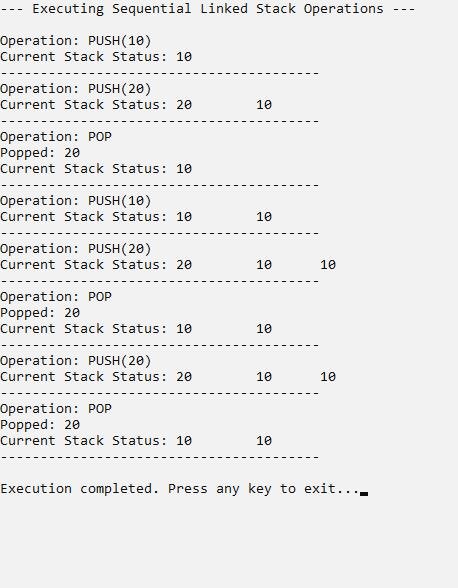
Output